

Looking back on a remarkable year
As you reflect on 2025, you may feel a well-earned sense of relief. After all, it was only nine months ago that markets seemed to come apart at the seams following the announcement of sweeping US tariffs and the uncertainty around their global reach.
In 2025, the S&P 500 posted a return of approximately 17.88%. One might glance at that number and assume it was a smooth, straight line from point A to point B. Nothing could be further from the truth.
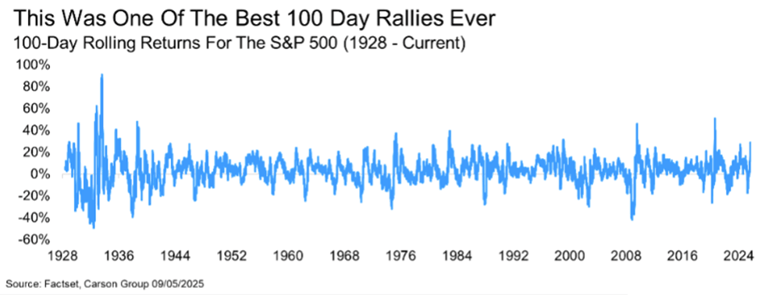
From February 19th to April 7th, the index fell roughly 21%, only to pivot and stage one of the most impressive recoveries in market history, rising 43% from the early April trough, through the October 29th peak. Annualized, that 140-day burst would equate to a +70% annual return, compared with the S&P 500’s long-run average of 10.5%. Just for context, some of the fastest market surges on record occurred in 1933 and 2020, when stocks rallied 40-50% in roughly 50-100 days. On a speed basis, the 2025 April-October run ranks as a top decile rally in the post 1950s era, even if not the single fastest.
Theme One: Risks are in plain sight
While the markets will likely post very impressive returns for 2025 on the heels of a generally great run since the 2020 pandemic, there are a couple of risks in plain sight for investors.
What you started with, might not be what you have today
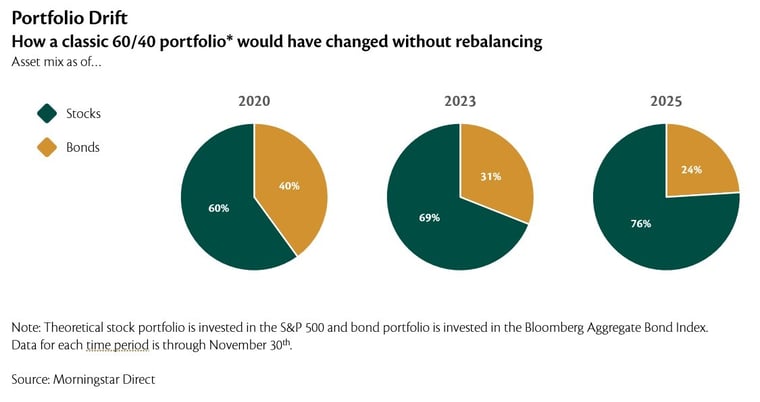
Robust equity performance can often push portfolios out of alignment with their long-term strategic targets. That classic, steady-eddy 60% stock and 40% bond portfolio may now look closer to a 76/24 portfolio because stock returns have significantly outperformed bonds. This effect compounds when portfolios go multiple years without rebalancing (as demonstrated in the diagram below). Portfolios may be misaligned with the risk tolerances of investors.
Index Diversification: not what it once was
For decades, the timeless advice has been to diversify – avoid concentrated bets on individual companies and instead own broadly diversified strategies. Historically, that included investments in S&P 500 and Russell 3000 index funds which essentially “own the entire market.”
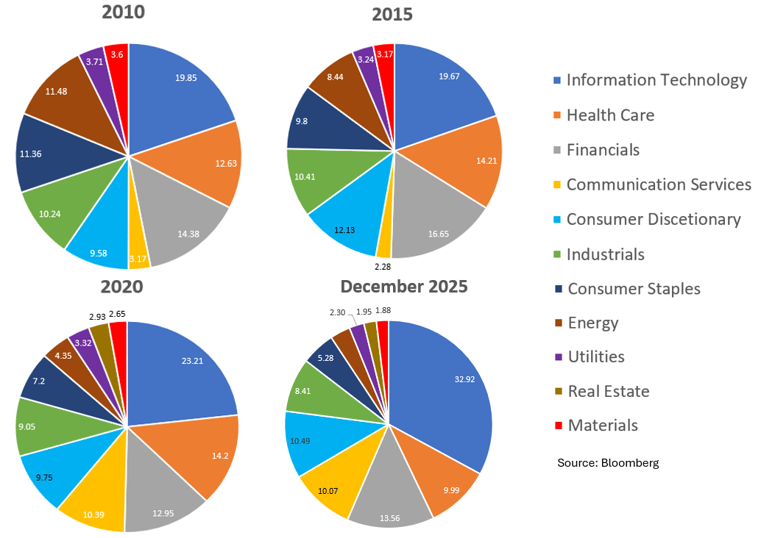
Ten years ago, that logic was sound. Today, the landscape has changed altogether. A combination of massive inflows into passive indexing and the secular boom in artificial intelligence “AI” has driven exceptional growth to a handful of mega-cap companies (think of giants like Nvidia, Microsoft, and Google). The result is that that US indexes have become far more “top-heavy” than in prior decades.
In just five years:
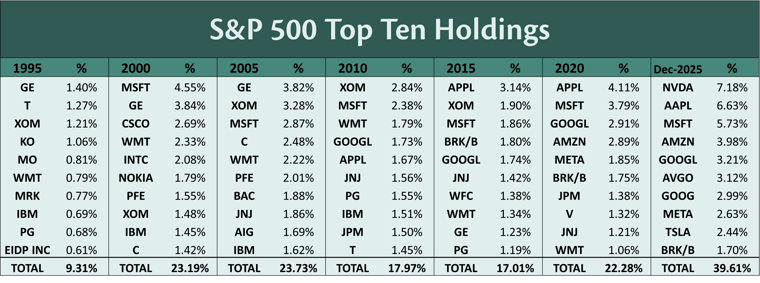
- The top holdings of the S&P 500 have growth from 22% of the index to almost 40% today – eight of which are highly tied to the AI trade.
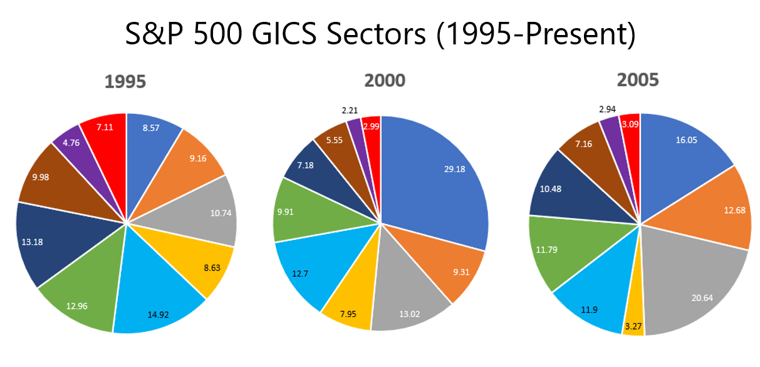
- The information technology sector has expanded from 23% to 33% of the index.
Plainly speaking, this means that investors should not assume that “owning the index” provides the broad diversification it once did. Today, buying the S&P 500 allocates nearly 40% of your dollars to just ten companies, all concentrated in a single sector. We remain optimistic about the long-term potential of AI, but history reminds us that early leaders in technological revolutions are not always the eventual winners.
Theme Two: There Is No Alternative (TINA)...Not Anymore
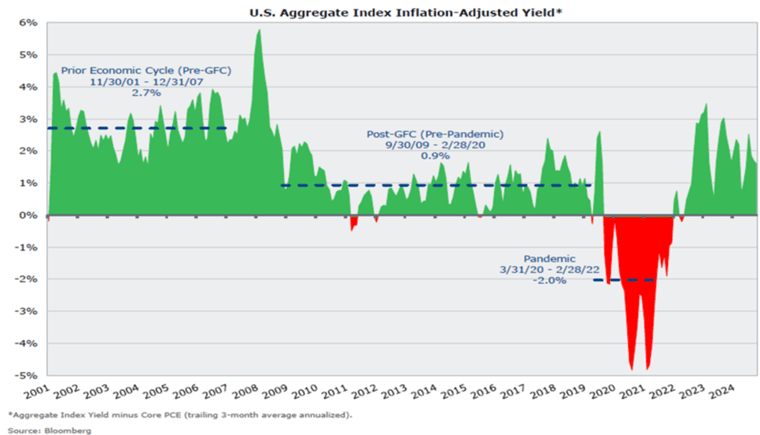
It wasn’t too long ago that bonds offered negative real returns (this happens when interest rates are below the rate of inflation). From July 2019 through March 2022, US 10-year bonds yielded below 2.00%, reaching a historic low near 0.50% during the pandemic. In that environment, the acronym TINA – There Is No Alternative – become shorthand for the dilemma facing many income-focused investors. In a time of low bond yields, many investors moved into higher risk credit and dividend-paying equities simply to replace lost income.
Fast forward to today. Inflation has eased from its 2022 highs, and the Federal Reserve has been deliberate and measured in shifting to a lower-rate stance. The end result of this has been strong real returns from bonds (i.e. returns above the rate of inflation) and a wide menu of attractive fixed income options. TINA, at least for now, has been retired. Bonds are back. Investors have been quick to capitalize on these opportunities. In 2024, bond ETFs and mutual funds saw $491 BN of inflows from investors. Moreover, 2025 is on track to be another strong year for bond flows, with nearly half a trillion dollars in inflows projected by this year end.
Real Yields are Positive
Theme Three: Scaling Uncertainty – Will the wall of worry continue to be built?
Markets have continually climbed a “wall of worry.” Even as investor concerns persist, the equity markets continue to trade higher. Investor concerns have been plentiful, ranging from questions about the durability of the US consumer to the potential for escalating geopolitical conflict.
The US economy is driven largely by the consumer. Government stimulus and low interest rates supported strong consumption for years, but some recent trends suggest a potential shift in this dynamic. Today consumers face higher borrowing costs and inflation in key categories like housing and food. If US consumers significantly slow their spending, the stock market could come under pressure.
The risk of geopolitical conflict remains elevated, following for example, recent government action in Venezuela and the Americas as a whole combined with the potential of US and China trade tensions escalating. These risks are important for the stock market as the supply chains of many companies are international, and some inputs, like rare-earth materials, are hard to find outside China. Conflicts in the Middle East, as well as with Russia and Ukraine could intensify.
In 2026, we will see how many proverbial bricks are still available to build this wall of worry. It’s quite possible that markets will continue to charge higher despite these headwinds. It also wouldn’t be surprising that this wall tumbles under the weight of multiple converging risks.
What should investors do?
Evolving markets and challenging times are nothing new for Tompkins Financial Advisors. Below are some strategies we are actively employing for clients.
Reviewing Investment Objectives and Rebalancing
It’s always important for investors to review their goals and objectives. For investors who have seen their stock portfolios grow significantly more than fixed income, they should consider rebalancing in the near term. Doing so allows you to capture a portion of your equity gains, while reducing risk by allocating proceeds into higher-quality fixed income securities. Our Wealth Advisors work closely with clients to ensure rebalancing is done in a thoughtful and tax-efficient manner.
Risk management is central to how we manage money. We know that this simple discipline helps avoid unpleasant surprises down the road.
Global Diversification Still Works
While US indexes have become increasingly narrow, international diversification continues to add meaningful value. As investment managers, we maintain a global lens, investing across a wide range of high-quality businesses in both developed and emerging markets. Each of our actively managed strategies includes a strategic allocation to international equities that ranges anywhere from 20-30%, depending on the prevailing market environment. Geographic diversification is central to how we build resilient portfolios that consistently compound growth and support long-term wealth creation for our clients.
Investing Across Market Caps
We believe diversifying across market capitalizations (i.e. investing in different sized companies) remains an important tool for managing risk and capturing opportunities. Even though US large cap stocks have driven recent market performance, leadership can shift as economic conditions change. By diversifying beyond the mega cap names that have outperformed in 2025, one can enhance return potential, especially during periods of economic normalization or easing financial conditions.
Seeking Income
We have always believed that high-quality, diversified fixed income is essential to building resilient portfolios. Fixed income securities offer reliable income and provide critical downside protection during equity market stress.
In Closing
While there are changes to the investing landscape, which we’ve detailed, uncertainty remains a constant. History reminds us that disciplined strategies, thoughtful diversification, and proactive risk management are the most effective tools for navigating market volatility. At Tompkins Financial Advisors, we believe that staying invested, rebalancing portfolios, and seeking quality income opportunities will position investors to weather the unknown and steadily compound growth over time. The bricks of worry may keep stacking, but with a clear plan and steady execution, investors can safeguard assets and grow their wealth, staying on track to achieve their long-term goals.
https://www.tompkinsfinancialadvisors.com/about-us/contact-us
Investments and insurance products are not insured by the FDIC, not deposits of, obligations of, or guaranteed by the bank or its affiliates, and are subject to investment risk including possible loss of principal. The opinions voiced in this material are for general information only and are not intended to provide specific advice or recommendations for any individual.